

How Do You Find Items Indoors? A Guide to RFID, BLE, UWB, Computer Vision and Light-Guided Picking
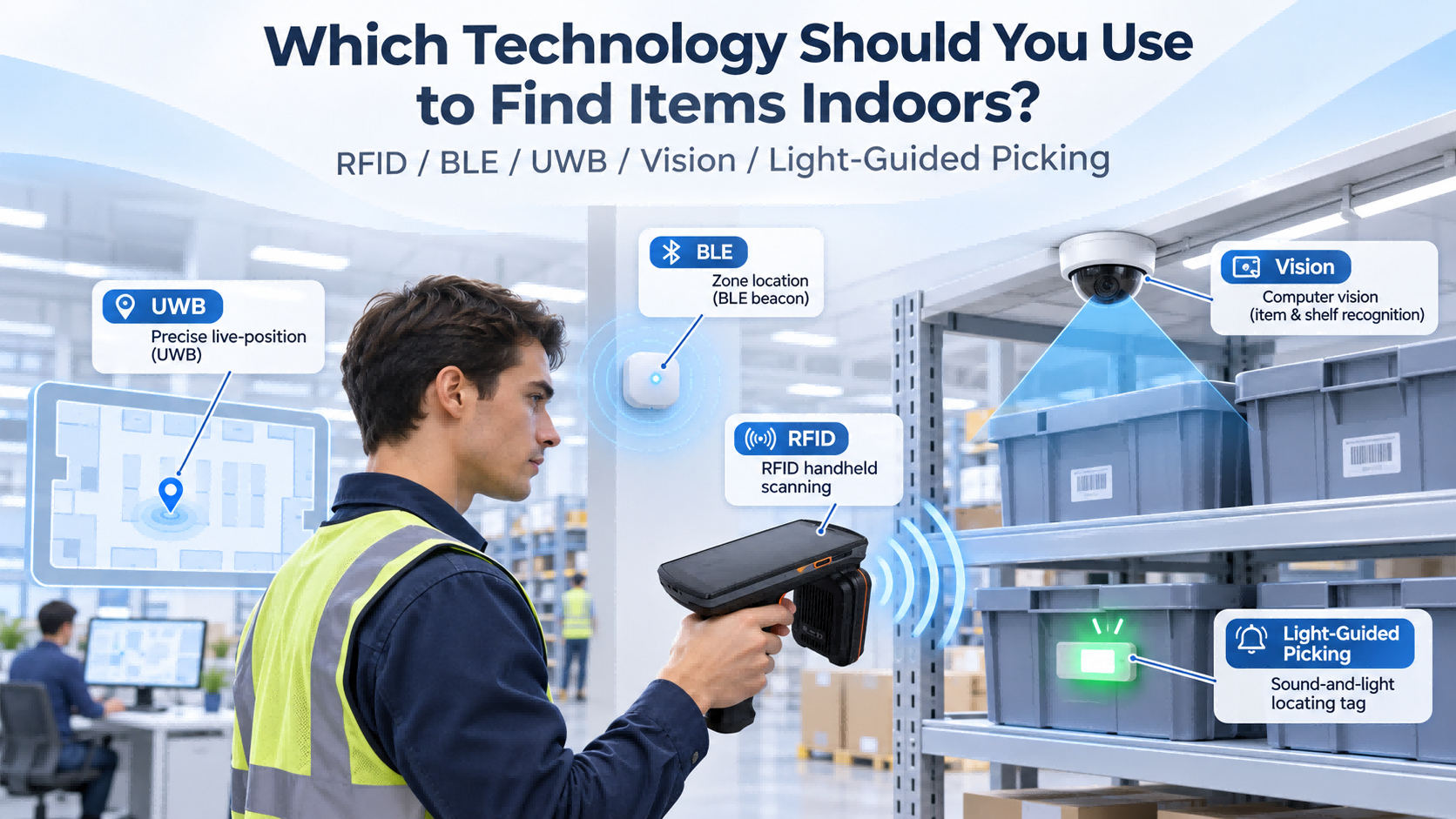
“Can your RFID system tell me exactly where my item is?”
Consider a customer waiting for a black jacket in size M. The stock record shows one available, but the store associate faces six rails of similar jackets. What would help most: the garment’s last recorded location, a handheld reader that can detect its tag, or a live point on a map?
The answer depends on where the search slows down and how recently the item may have moved.
Use passive UHF RFID when staff need to count tagged goods and search for a particular item. Bluetooth Low Energy (BLE) can help identify which room or zone to search. Ultra-wideband (UWB) can provide updated coordinates when a decision depends on the position of a moving asset. Computer vision adds information about visible actions. If the worker already knows the rack, a light or buzzer on the target item or bin can guide the final pick.
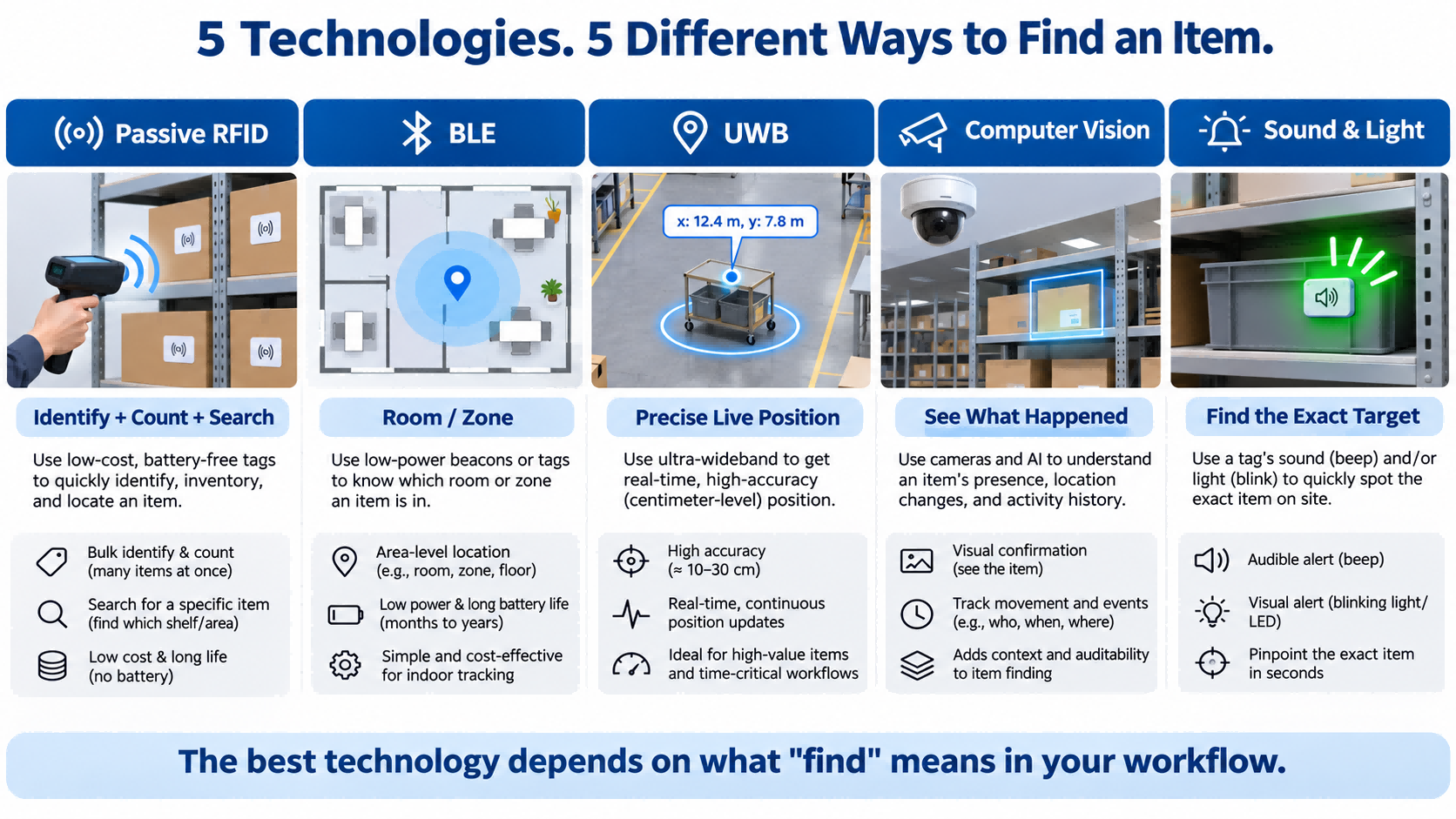
| Approach | What the employee gets | What the system needs | What to check on site |
| Passive UHF RFID | A record of which tags were detected, plus handheld search feedback for a selected tag | Compatible tags and readers, with each tag linked to the correct item record | Can staff find the target among similar items in its normal storage conditions? |
| BLE | A room or zone estimate, or more precise position information with a suitable installation | Compatible tags and receivers arranged for the required coverage | Does the system assign the correct room when equipment sits near a shared wall? |
| UWB | Distance measurements or updated coordinates for a moving asset | Compatible devices and positioning infrastructure for the area being tracked | How accurate and how recent is the displayed position along the routes that matter? |
| Computer vision | A record of visible actions, such as a box being picked up or returned | Camera coverage, adequate lighting and software suited to the task | Can the system distinguish events when people or objects block one another? |
| Sound-and-light guidance | A visible or audible cue from the assigned item, bin or storage position | A powered device, communication coverage and a correct assignment | Does the cue identify the item itself or only the place where staff expect to find it? |
Sound and light serve a different role within a locating system. The light directs a worker’s attention to a device the software has selected. What the worker finds there depends on where the device is attached and whether its assignment is current.
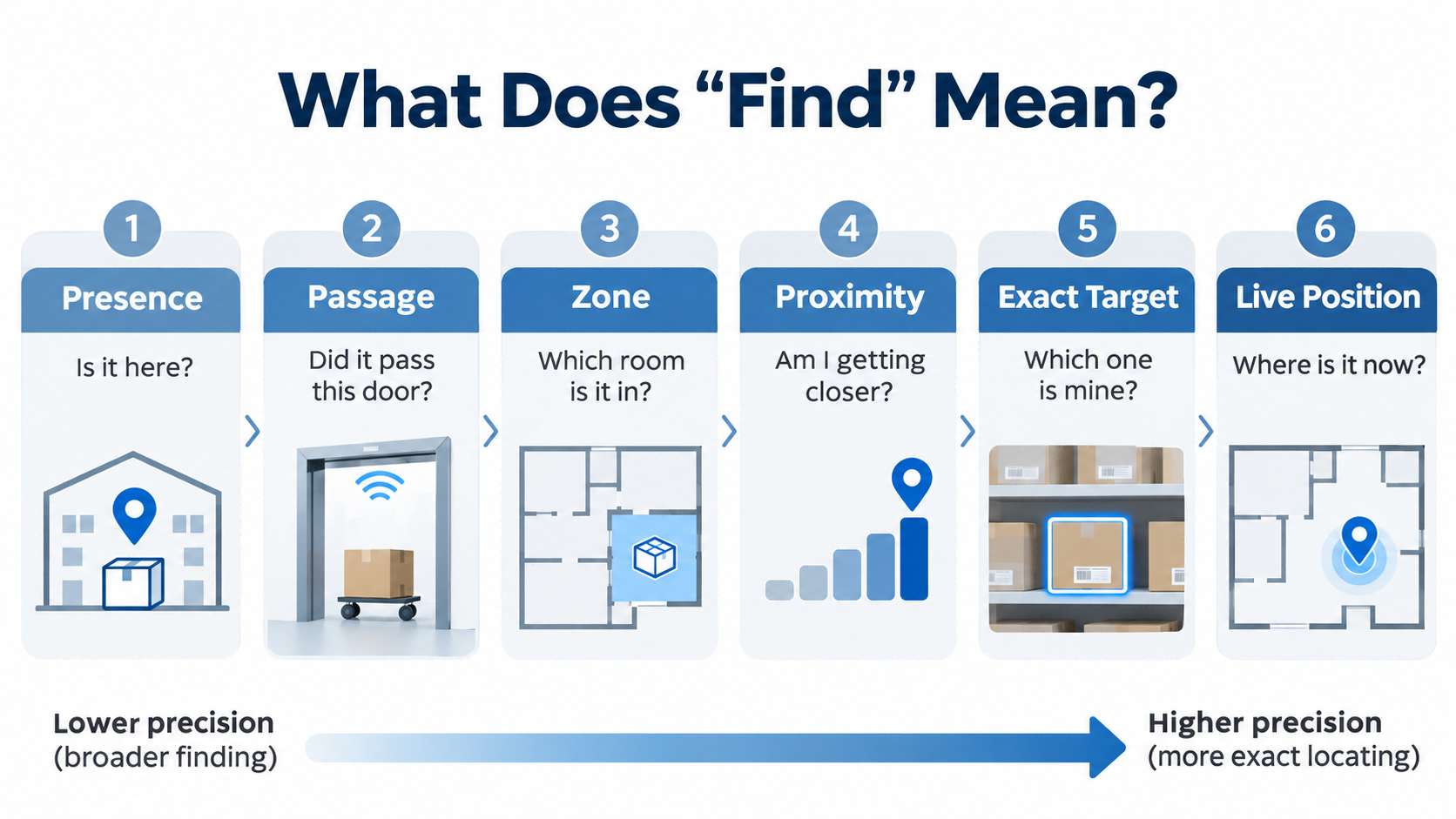
Start with the decision the employee needs to make. These six questions describe different requirements.
| Locating need | A question from the floor |
| Presence | Did we detect this garment during today’s stockroom count? |
| Passage | Did this carton leave through the dispatch door? |
| Zone | Which room should I visit to collect the infusion pump? |
| Proximity | Where along these rails can my handheld detect the target tag? |
| Exact target | Which of these 25 similar bins should I pick from? |
| Live position | Where is Cart 17 now, and when did its position last update? |
.
The distinction affects what you buy. A store associate may be able to retrieve a jacket using its expected stockroom and a handheld search. A dispatcher choosing between two moving carts needs positions recent enough to decide which cart to send.
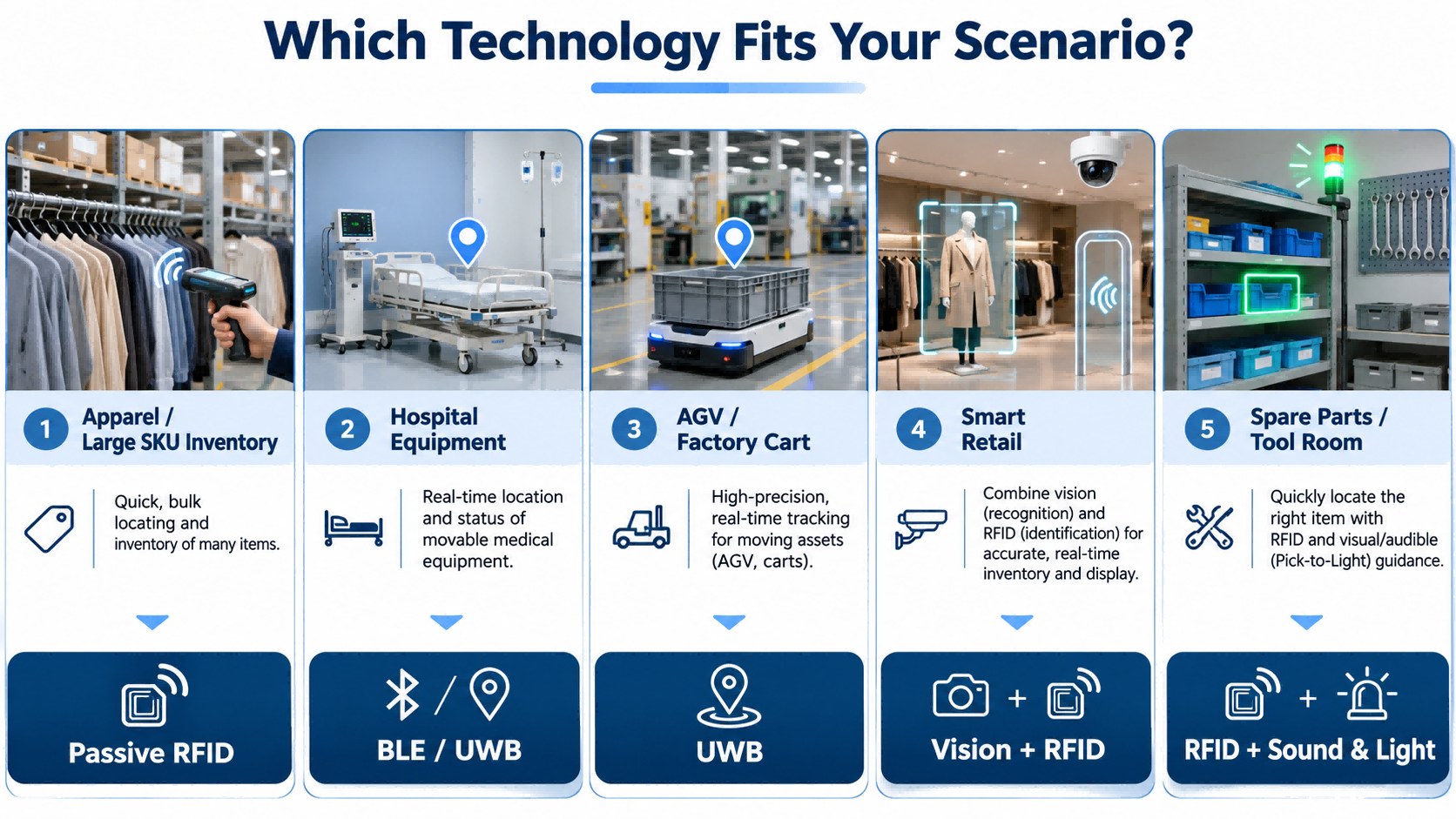
Passive UHF RFID is a practical starting point when a business handles many individual items, counts them regularly and occasionally needs to find one. Each passive tag can carry a unique identifier and operates without an onboard battery. The inventory software links the identifier to a garment, tool, carton or other tracked unit.
In the jacket example, the associate selects the requested style, color and size. If the customer will accept any matching jacket, the search application needs to identify eligible units. If the order is reserved against one particular garment, the associate needs its individual tag identifier.
The associate can then walk the likely storage area with a handheld reader. Signal feedback helps narrow the search. Tag orientation, nearby metal and reflections can affect that feedback, so the operator may need to approach a rail from another angle. At the rail, the associate checks the garment and size before completing the order.
A fixed reader answers a different question. A record stating Carton 248 was detected at Dispatch Door 2 at 10:42 gives staff a time and place to investigate. Recording Carton 248 left the warehouse also requires evidence that it crossed the doorway outbound. A carton waiting beside the door illustrates why the distinction matters.
Consider BLE when knowing which room to visit would save most of the search time. A hospital employee looking for a portable pump may only need a dependable room estimate. Test the difficult boundary: place the pump next to a shared wall, move it into the adjoining room and measure how quickly the displayed room changes. BLE also supports direction-finding methods where the application needs finer positioning and the installation supports it. Bluetooth SIG — Direction Finding
Consider UWB when the position of an asset within a room changes an operational decision. Imagine 80 production carts moving between assembly, inspection and shipping. Knowing that Cart 17 entered the assembly hall helps someone start looking. Dispatching the nearest available cart requires a position estimate inside the hall and a timestamp recent enough to act on. UWB can measure signal time of flight between compatible devices. A positioning system uses those measurements and its installed infrastructure to estimate the cart’s location. FiRa Consortium — How UWB Works
Deployment scale affects the economics. For 80 reusable carts, compare the value of faster dispatch against tags, installation and ongoing maintenance. For thousands of low-value garments, compare the cost per tagged unit against the value of faster stocktaking and occasional retrieval. Use the number of physical items in the calculation. One apparel SKU may represent hundreds of garments.
Computer vision helps when staff need to understand an action. A camera may show that a shopper lifted a box from a display and returned it. RFID can supply the identifiers of tagged products detected nearby. If several similar boxes are within range, attributing the action to one box requires matching the timing, read zone and visual event. A useful pilot has two people handle adjacent products at the same time and checks whether the system assigns each event correctly.
Sound-and-light guidance helps when staff know the area but still struggle to select the target. In a textile warehouse, several fabric rolls may look alike. A reusable light tag attached to an individual roll can flash or sound when the picker selects that roll in the software. The picker follows the cue and verifies the roll against the order. When staff transfer the device to a new roll, they must update its assignment.
A light fixed to a spare-parts bin behaves differently. It guides the employee to that storage position. If the order calls for four brake levers, the employee still checks the part and quantity. This difference matters whenever stock can be moved without moving the light.
Set a target the operations team can observe. For example: A new employee should be able to retrieve the correct fabric roll within two minutes. That gives you a common test for your current process, a handheld search and light-guided picking.
| Pilot question | What to measure |
| Can employees finish the task? | Time from request to verified retrieval, successful searches, wrong picks and requests for help |
| Can they trust the displayed location? | Correct room or zone, time since the last observation and delay after an item moves |
| Does the approach work during a normal shift? | Results with full racks, adjacent rooms, similar stock and ordinary staff traffic |
| What will it cost to maintain? | Devices per item or bin, readers and installation, battery servicing, replacements and time spent reassigning devices |
Include one deliberately misplaced item. When everything sits in its assigned bin, even a printed location list may perform well. Move a tagged part to an adjacent shelf and leave its record unchanged. Can the employee recover it? Does the screen show when the location was last verified? If a light activates, does it lead to the part or to its empty bin? This test reveals what the operator can actually rely on during a difficult search.
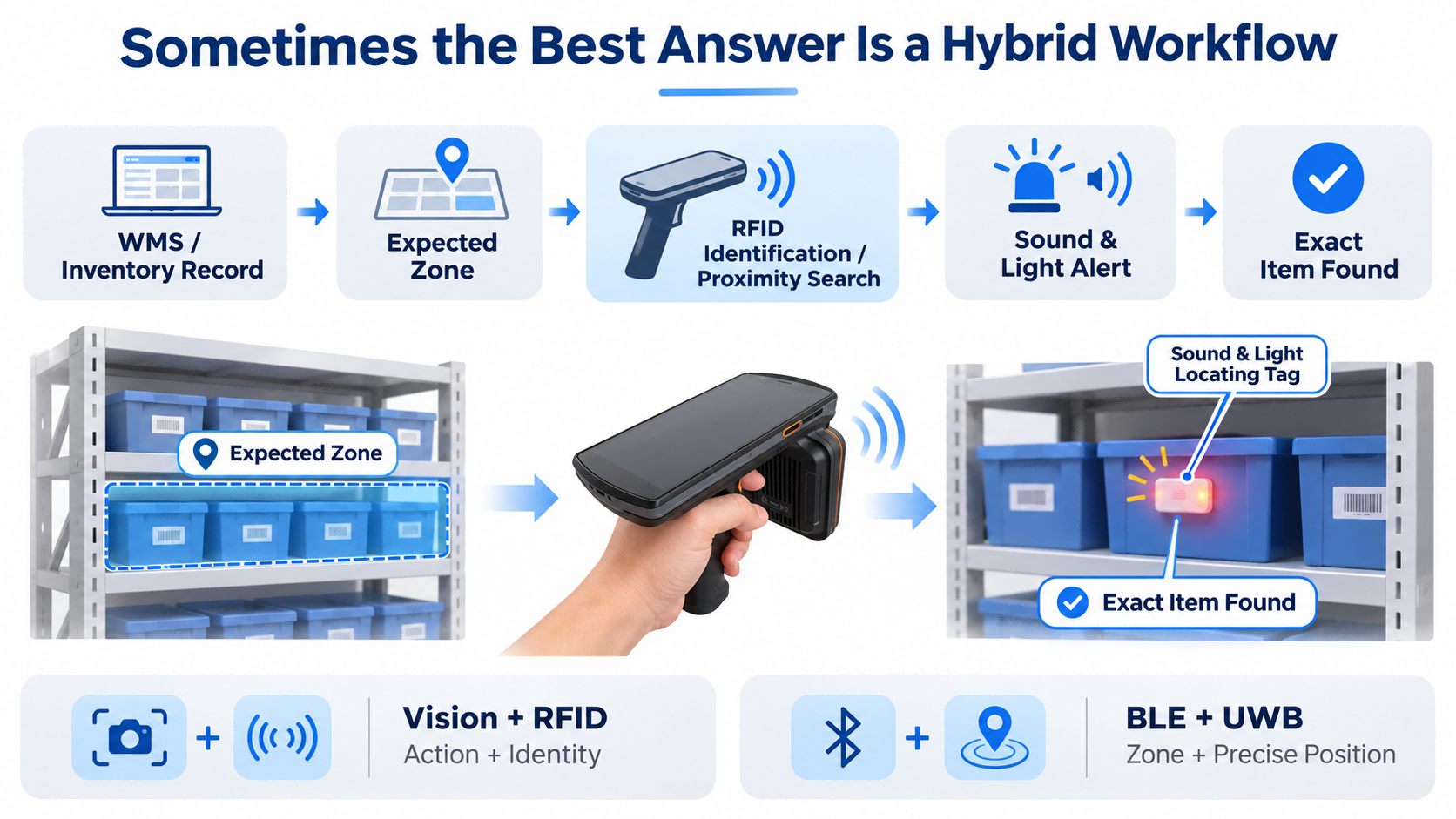
A useful starting point for FYJ is to follow one retrieval from the inventory record to the employee’s hand. If an apparel associate spends most of the search checking rails for a particular size, FYJ’s RFID batch stocktaking and handheld item-finding workflows can use the same garment identifiers for both tasks. If a parts picker reaches the correct rack quickly but loses time comparing similar bins, FYJ’s smart sound-and-light guidance addresses that step directly.
To define your own requirement, take one item employees struggled to find last week. Write down where the system said it was, where the employee actually found it and what confirmed it was the right item. Those three details give a supplier a concrete task to demonstrate.
Can I use my existing inventory RFID tags to find a specific item?
Yes, if each target item has a unique tag identifier, that identifier is linked to its record, and your handheld reader and software support searching for it. Start by choosing two identical products in your inventory system. If staff can select each physical unit separately and retrieve the matching one, you have verified the workflow that matters.
If my warehouse software already records bin locations, what would a locating system add?
It depends on where searches fail. If employees reach the correct rack but confuse neighboring bins, a bin light can guide the pick. If goods are frequently put away in the wrong place, a light fixed to the expected bin will still point there. In that case, test whether staff can recover a misplaced item using a handheld RFID search or a compatible locating device attached to the item itself.
How can I tell whether we need a real-time location system?
Ask what decision becomes unreliable as a location record ages. An employee retrieving a tool once a week may meet the retrieval target using its last recorded zone and an on-demand search. A dispatcher selecting the nearest moving cart may need frequent position updates. For that project, specify both the acceptable position error and the maximum delay before movement appears on the map.
Hi! Click one of our members below to chat on
 ar


 دعم شبكة IPv6